recent works
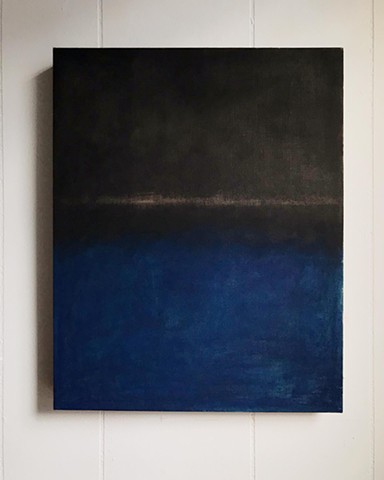
Black and Blue
Sumi ink, wax pastel on linen on wood panel
20 × 15 × 1-3/4 inches
“Black and blue” is the familiar language used to describe the visible aftermath of physical violence, although a bruise is rarely literally black and blue. It moves through reds, purples, yellows, greens, and browns as the body responds to injury.
Black and blue is the label society has given it. The painting takes that label literally and then abstracts it. The body disappears from the image. What remains are fields of black and blue separated by a narrow rupture—the violence itself absent, its residue still present.
But Black and Blue carries another meaning. Black invokes Blackness; blue invokes the police. Their relationship calls attention to an asymmetry of institutional power and to the disproportionate violence experienced by Black and brown people through policing. In this reading, the familiar phrase becomes more disturbing: blue is no longer simply the color of the bruise. It can also signify the institution capable of inflicting it.
This was a challenging work for me because the conflict between black and blue was not theoretical. I do not trust the police. My activism has included opposition to policing and incarceration because I understand them as systems in which racism, inequality, and violence are embedded. I did not want another Black man incarcerated. The respondent is Black, and when I was first confronted with the question of reporting his violence, I was also confronted with what reporting meant: turning to a system I fundamentally distrusted and asking that system to intervene.
The first time he was violent toward me, I went to the police, but I later recanted. My conflict about policing and incarceration contributed to that change of mind. It took four separate escapes from violent situations before I fully understood that I needed protection and that he needed to be held accountable. How could I ask an institution I regarded as racist to protect me? How could I press charges when I opposed the system through which those charges would be enforced? These were not abstract political questions. I was trying to reconcile my beliefs about institutional violence with the violence occurring in my own life.
The conflict was further complicated by what happened when I tried to leave. Each time I escaped, the respondent accused me of being racist. Those accusations were particularly difficult for me because they reached directly into beliefs I already held deeply about racism, policing, and the unequal treatment of Black people in America. He knew this about me. I was already struggling with whether seeking intervention from a system I regarded as racist could itself participate in racial injustice; at the same time, I was being accused of racism by the person whose violence I was trying to escape.
Eventually, I had to separate those questions. Leaving violence was not an act of racism. Naming violence was not an act of racism. Seeking protection from violence was not an act of racism. I could examine the racism of institutions without allowing an accusation of racism to prevent me from protecting myself. For me, seeking protection was ultimately an act of prevention. I could oppose a system I understood as racist while also recognizing that my opposition to that system could not require me to remain vulnerable to another person’s violence. Accountability, for me, was not about punishment. It was about preventing the violence from continuing.
After my final escape, I came to understand something I had been unable to reconcile before: opposition to a system of racialized policing could not require me to absorb another person’s violence in order to protect him from that system. His race did not make his violence less violent, and my opposition to policing did not make me responsible for shielding him from accountability. Violence must be held accountable regardless of race, religion, gender, culture, class, or social identity.
Black and Blue holds that contradiction without resolving it neatly. It holds violence against the individual body alongside violence exercised through institutional power. It holds my distrust of the police alongside my need for protection. It holds my refusal to ignore racial injustice alongside my eventual understanding that acknowledging that injustice could not require the erasure of the violence being committed against me.
Black and Blue refuses to make the subject comfortable. It does not abandon my critique of policing in order to confront interpersonal violence, nor does it minimize interpersonal violence in order to preserve that critique. The work insists on holding both realities in view simultaneously.
Neither truth requires the erasure of the other.
The work does not illustrate violence; it examines the systems of language, power, and recognition through which violence becomes visible—or remains unseen.
"In this article we pay attention to the violence which, due to the fear of social stigma, could be hidden from the public eye for a long time but could have serious health consequences for the individual, family, and society – physical and psychological forms of domestic violence and abuse in male-female intimate relationship. Besides its nature and extent data in general population, we review also the surveys data about its theoretical basis, its risk factors and possible effects on mental and physical health, not only on in conflicts involved partners, but also on family as a whole, and especially on the children that growing up in such a problematic domestic circumstances."